Showing posts with label Investing and Finance. Show all posts

Friday, December 25, 2009

An exclusive Interview from CNBC with the world 2 greatest minds

An exclusive Interview from CNBC with the world 2 greatest minds
Warren buffett and bill gates


What do you advice for people starting out in the society who is a little confuse on where to go ?

Bill : for me, I was lucky I got started very early as in I was kind of obsess with what I do

Buffett: marry the right person, it will trigger all your inspiration and change u as a person
Work not for the dollar but for someone (or company) who you really admire
And read everything again and again and again
And do that not for the money and you can truly enjoy what you do.


Alternative energy good area to invest >?

Bill : Not because we really do not know which one is the one to help us create the power we need, nuclear, wind, solar etc not enough r n d is done but one will emerge which is going to save us time cost and do no harm to the environment.

Investing


Buffett: Look not at the current situation but at the long term perspective of a company because as long it’s a good business, eventually overtime its going to be bigger as the population demands business grows, so look long term, I dont bother with what happening now, next week, next month, long term perspective.

Burlington rail why?


Buffett: Cos transport is cheaper, more environment friendly, goods are going to be shipped, by rail is far most enconomically, environmental friendly , and efficient
Petrol consumption example of rail and trucks. One rail is = 280 trucks. Etc
when the Country is good, the rail will be good.


What is the qualities that you have compare to others as there so many people who want to become the next bill, buffett etc but most never make it

Bill: PASSION
WE DIDN’T do if for money although we knew we gonna get rich,

Buffet: a correct mentor, my mentor is Benjamin graham , and i got started very early and didn’t let others affect me, i believed in the right mentor, so when everyone esles was starting to oppose what i believe and what my mentor has taught me, i choose to focus only on my mentor teachings and beliefs.
And everyday I look at the mirror and its always agrees with me and I get out doing what I believe in

Business leaders should have what kind of character, and what makes your business so successful ?

Bill: Experience and always thinks on making our business harder for others to compete, making our business unique is important.

Buffett, do this business like a family business and you are not going to sell it, and is going to work on it for 100 years. that is the attitude i have and i share with all my business managers.

Bill, look long term, self confidence, believe that this is going to work out (like I dropped out of Harvard and ask my friends to help me, self confidence) and seized it (opportunity) cause its not going to come along that often

Most important mentors ?

Bill: dad mom, they were lawyers and my dad always share what he doing at work, really learn a lot and people from mensa who shares about the experiences and how they dealt with events in their life

Value investing fundamentals investing is very important but I heard you make a decision over 5 mins on investment in companies

Buffett: laughs ... that’s 50 years of preparation and 5 min of decision


Sunday, October 18, 2009

Market recovery ? Where this might all goes ?

An update on the current markert sentiments and this is a very interesting article which is more of what i see to what is happening, its from one of my mentor, good friend, Conrad, source from The pattern trader & Conrad alvin lim blog

Hold your breath. It’s that time of the year … the time of the year when the market either makes it or breaks it. It’s Crash or Rally time.

We are all familiar with all the bad news that comes with this period of trading. Here’s a brief recap:
1929, Oct 24 (Black Thursday) The Great Depression
1929, Oct 29 (Black Tuesday) The Great Depression
1987, Oct 19 ((Black Monday)
1997, Oct 22 (Asian Financial Crisis) DOW lost more than 11% in 4 consecutive down days.
2007, Oct 10 - Start of the Sub-prime Mortgage Crisis Decline
2008, Oct 06 to 10 (Black Week) The “Panic of 2008″. DOW closes below 10,000 on Oct 6 for the first time since Oct 26, 2004
2008, Oct 09 & 15 2008 - DOW loses more than 7% on each day.
2008, Oct 24 (Black Friday) World markets lose more than 10% in one session

Now, also take note that when the market was at a bottom or recovering from a bottom, Octobers were great rally starters;
1921, October - After a three year low in August that year, DOW went on to gain 446% over the next 8 years that led into the Crash of ‘29.
1934, October - Having recovered from the Great Depression, the market gained 110% over the next 28 months.
1949, October - After finding a 4 year low in June, the market broke its 52 week high and started a 16 year bull run that took the DOW from 190 to 988 by Jan 1966.
1982, October - Dow breaks above 1,000 and gets above its 10 year high and starts a 5 year rally that extends beyond 150% before breaking down in October 1987.
1987, October - After that spectacular break down, Dow started an immediate recovery that went from 1,840 to 3,000 (63%) in 33 months and peaked out at 3,000 by July 1990.
1990 October - Dow pulled back from 3,000 in July 1990 to 2,365 by October that same year and found a bottom which rallied to 9,340 (294%) in 8 years, ending with the Russian Financial Crisis in 1998.
1998, October - The Russian Financial Crisis ended with a Double Bottom and rallied the DOW from 7,631 to 11,107 by May 1999 for a gain of 45.5% in only 7 months.
2002, October 10 - DOW found the Dot.com recession bottom at 7,286 and went into a 16 month recovery that topped out in February 11, 2004 at 10,737 for a 47% gain (albeit with a scare between January and March of 2003).
2005, October - Dow holds above 10,200 in a two year consolidation and breaks out the following November and makes a two year run to the all time high of 14,164 by October 9, 2007 for a 38.8% gain.
So what can we expect this time; Tank or Rally?

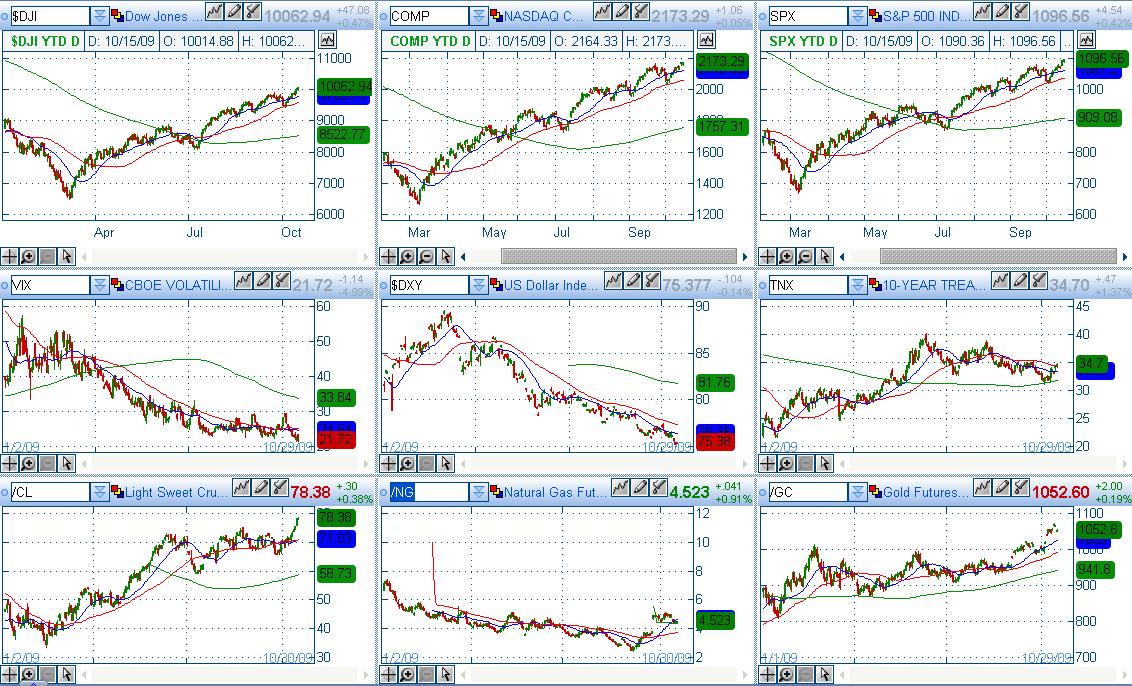
Dow, Nasdaq, S&P500, VIX, Dollar, 10yr, Oil, Nat Gas & Gold
This market is doing things I’ve never seen before and is making unprecedented patterns not seen in history;
The benchmarks are cracking new highs with the DOW breaking and holding above 10,000 and staying well above its 200DSMA while the VIX is at a 14 month low of 21.72 and the 10yr Treasury Yield’s two month decline indicating a return to a bull market.
But the dollar is at shark-shit lows, Oil is climbing unbelievably above $78 and Gold is no less crazy above $1,050 indicating an onset of inflation against the back drop of that weakening dollar while Natural Gas remains unnaturally and divergently low below $5.
And how is it logical to have inflationary commodity prices when Americans don’t have incomes, jobs and the kind of spending power to support $78 oil and $1,050 gold?
The economy is undoubtedly still very weak and the pain in America is still quite bad. The fundamentals of the country just don’t justify the rally we are seeing and it would be foolish and too soon to assume that the economy is truly in a recovery state. But the market can be a different factor altogether. Seldom in history has the economy led the market. Statistics show that the market has often led the economy, sometimes regardless of the economic fundamentals.


In recent times, the market rallied without really recovering from;
the 1973/74 Oil Crisis and the dollar’s divorce from the gold standard,
1987 inflationary recession,
the 1997 Asian Financial Crisis (economic recovery was lagging by then),
the 2000 LTCM debacle,
the Dot.com deflation the 2001,
SARS in 2002
and it would seem, now in 2009 during the Financial Crisis.
I have little faith that this rally is sustainable and will continue to hold on to my 20 year cycle theory. But what is undeniable is the money making opportunities that have presented themselves over the last 7 months. Markets will tank and markets will rally. What matters more than a bearish opinion is that one makes money regardless of that opinion. I find it foolish to hold to the market’s fundamentals and deny an “empty” rally that is so ridiculously profitable, hyped or not.
Missing out on a 53.7% rally does not an intelligent trader make.
At the same time, committing more than 50% of your cash to trading this rally is even more foolish. Knowing that the fundamentals will catch up with the market sooner or later, makes highly leveraged trading a dangerously foolish prospect for now. With most of the pros and high-leveraged players staying sidelined or playing it conservatively, taking on this market with guns blazing will get you killed as surely as the last mad rush by Butch Cassidy and the Sundance Kid.
Play it safe. Buy some insurance. Spread it. Hedge it. Trade this market bullishly by all means but always protect yourself and keep your stops tight. Better to get stopped out in small profits than risk wiping out half or all of your capital. If the market continues to run, at least you’re not missing out. If it tanks suddenly, you’re prepared for the worst. Calculate your risk and stick to your rules. Don’t think about it when the shit hits the fan - just do it and take the pain. It’s a short stab and it’ll hurt. But like all bitter medicine, it is a good thing.
Remember that this rally is fuelled by ignorance and hype. Such “buy the rumor, sell the news” investors have been responsible for some of the worst market bubbles in the history of the stock market. And you know what always follows a bubble.

The property scene in Singapore is no different. What makes this bubble even more hazardous is that these investors are flipping with borrowed money. God forbid a property market correction - banks are going to be holding a large portion of our housing inventory then and owners are going to be paying for mortgages that are above the lower selling price - defaults will surely rise.

In parting, allow me to leave you with a wise quotation by Joseph Patrick Kennedy from 1929;
Even when shoe shine boys are giving you stock tips, it’s time to sell.
Have a great weekend from conrad lim


Love aai family
- li shao / Andrew tan

Friday, July 17, 2009

Recession ending... fragile recovery in process

Recession Ending...Fragile Recovery in ProcessGlobal

economists now believe the global recession ended in Q2'2009 and a fragile recovery has begun in the third quarter. Growth forecasts up being revised upwards across the globe, but most notably in the US and China. The 2010 global GDP forecast is now 3.7%, with GDP growth in the emerging markets at 5.5% forecast to outperform growth in developed markets at 2.2%.

THE International Monetary Fund on Wednesday raised its outlook for the global economy in 2010, but said recovery from the worst recession since World War II would be sluggish. The IMF boosted its 2010 global growth forecast to 2.5 per cent, an improvement of 0.6 point from its April forecast. However, the global recovery is not yet self- sustaining and is likely to be very slow.

Singapore Market Update
On 16 July, Singapore reported growth of 20.4% in second quarter'09 GDP over the previous quarter, making Singapore the first Asian economy to get out of a technical recession. The government has raised the 2009 growth forecast from to -4% to -6% this year. However, there is caution in the fact that one quarter of growth does not signify a definite upward trend. At the same time, it is agreed that the recovery process remains frought with risks. Markets can still be shaken by bad news from global economies.

Remember however that the stock market anticipates the economy and moves up 6-12 months before the economy recovers and that is why the STI has been rallying so strongly for the past 4 months.

Action on PortfolioThe current PE ratio of the STI is about 12, slightly undervalued from the historical average of 15. At it's current level of 2,300 points, it has got a 65% upside to its pre-crisis level of 3800 points. Of course, this will not happen overnight, with lots of ups and downs along the way. Since the STI hit its recent high of 2,400, it has only pulled back 5% to its current level.

While I wished the market could have gone a lot lower, there is a strong possibility there is more near term upside given the stronger than expected economic data. I do not hold any singapore stocks but my good friend and Adam has started to buy back his core holdings of STI ETF, SGX, Capitaland and UOB. However, there are current only slightly undervalued so he is only taking a small position. its all about patience and we are both hoping for more downside so that we can buy more at a bigger discount in the next few months.

These are his recent buys:
15 Jul Buy STI ETF at $2.40
15 Jul Buy SGX at $7.05
15 Jul Buy UOB at $14.90
14 Jul Buy Capitaland at $3.40

* Note that STI ETF is not reflected in the online portfolio because of technical reasons, the market data cannot be pulled.

US Market Update
Up for a third consecutive session, the Dow Jones Industrial Average (DJI) climbed 158.10 points, or 1.9%, to 8,517.5. The S&P 500 Index (SPX) added 16.41 points, or 1.8%, to stand at 922.25, with materials and energy shares fronting the broad market gains, while the Nasdaq Composite (RIXF) rose 43.97 points, or 2.4%, to 1,843.7.

What's driving this rally? The start of this new earnings season has been very encouraging. Goldman Sachs (GS 149.66, +0.22) unveiled earnings of $4.93 per share for the second quarter. Johnson & Johnson (JNJ 58.23, +0.51) reported better-than-expected earnings and Intel also exceeded expectations. In addition, Well regarded Wall Street analyst Meredith Whitney encouraged buying in the financial sector by indicating that bank stocks have strong potential in the near-term. On the economic data side, PPI and Core PPI for June increase more than expected and advance Retail Sales increase more than expected.

I am more active in the U.S markets as there are more tools for research, Very risk averse kind
I have brought in alot during the BIG DISCOUNT period over the past few months, and currently i am only taking a small position, SNP ETF, FXI ETF, VISA Stock. For Visa its only slightly undervalued, where esle the ETFs, there at least another 50% to where it was during the peak, i am waiting for more downside so that i can buy more at a bigger discount in the next few months. And there is always the dip, correction, its all about consistent hardwork and constant learning.

For Adam he brought
14 Jul Add PG at $53.00 (new average price $55.03)
14 Jul Add USO at $32.50 (new average price $35.04)
14 Jul Add PEP at $55.70 (new average price $58.05)
14 Jul Add NKE at $51.60 (new average price $54.65)
15 Jul buy GE at $12
15 Jul buy V at $62.18
http://www.akltg.com

Live your dreams, take massive actions
be a MIRACLE MAKER!

Love andrew

Wednesday, July 15, 2009

Warren buffer interview by ABC

Warren Buffett, Chairman and CEO of Berkshire Hathaway was interviewed by ABC today, in which he gave a guided support for a second economic stimulus package.

Here are some quotes from the Buffett

1. On the second economic stimulus package:

“I think that a second one may well be called for," "you hope it doesn't get watered down in many ways." "Our first stimulus bill ... was sort of like taking half a tablet of Viagra and having also a bunch of candy mixed in ... as if everybody was putting in enough for their own constituents, it doesn't have really quite the wall that might have been anticipated there."

2. On government's public-private investment plan (PPIP)

"I do not like the idea of any kind of a plan involving the government where Wall Street makes a lot of money. My plan provided that they would make no money whatsoever, and the American public would make the money. I just think that Wall Street owes the American people one at this point,"

3. On economic recovery:

"We are not in a freefall, but we are not in a recovery either. We were in a freefall really in the last quarter of last year, starting in the financial markets and spreading to the economy, and we had this huge change in behavior. That change hasn't changed." "We didn't want to do it, and if we saw things coming back we wouldn't do it" (Buffett laid off 500 people from his own company)

4. On severity of current recession:

"I have never seen it quite happen like this, but what happened was in late September, the American public … saw money market funds break the buck. They saw commercial papers stop, they saw all kinds of things that they hadn't seen before,It was a shock to the system."

5. But in the end Buffett remains optimistic:

"I want to emphasize, we are going to come out of this better than ever," he said. "I mean the best days of America, by far, lie ahead. But not next week or next month and then, I don't know exactly when we will come out, but we will come out big time."

Tuesday, June 2, 2009

The Secret of Absolute Abundance and Wealth

The difference between the rich and the poor is not in how much money they have, but in the way they talk, the way they act and the way they think. The way you think is what you create in your inner world. The way you talk and act is what you express in your outer world. If you want to be truly wealthy, you must be act the same in your thoughts, speech and actions. Half belief results in half wealth. Poor people talk about what they dont have in every way while rich people talk about how they can have or going to get it in every way.

The elements in your environment affect your consciousness. Everything that you see around you will subconsciously impress upon you the idea of poverty or wealth. The more broken and dilapidated stuff you hold without replacing, the more you will feel lack. When you keep signs of abundance in your environment, your subconscious mind will be constantly impressed with the idea of supply and abundance. By causing yourself to feel abundance, you will perpetuate the conditions of abundance in your reality.

The subconscious impression of abundance creates conditions of abundance. Seeing abundance in one area creates a mental shift and allows you to start seeing and feeling more abundance in your life. Whatever area in your life you have right now that makes you feel rich and powerful, create more of that. Use that area to affect other areas. The key is to get more references of abundance for you to be conscious of so as to impress upon your subconscious mind as much as possible the reality of abundance.

Your actions either create subconscious impressions of wealth or poverty. By choosing to buy the best and quality products for yourself, you are saying that you are worth it, that you are the best. Your subconscious mind will pick up these impressions from your actions and create conditions in your life that resonate with that state of mind. To manifest wealth, you must begin with living as though you are already wealthy. It doesn't mean you overspend, but you simply spend in a way that makes you truly happy.

Saturday, May 9, 2009

Market outlook May 09

Dear Friends, Those of you who have been following the market would know that stocks are continuing that huge rally that started in early March. For the last 2 months, the Dow Jones is up 26%, the S&P 500 Index is up 30% and the Straits Times Index is up 36%. Like I always say, what goes down MUST always come up...


Personally i am making gains on some stocks and will continue to increase when its goes thru a dip, my majority are still in indexes, mainly US and China.
Although the indexes and value stocks will EVENTUALLY go back to pre crisis levels in a few years, they will not go up in a straight line. There will be us and downs in between. The smart investor,taking profits when the rally in to fast and getting back in when the pull back happens will make even more money. But this is where your skills in technical analysis comes in.

STI Blue chips have been the largest gainers, like SGX up, UOB up, Capitaland up 65% and OCBC up 61%. It is always wise to sell in batches and take profits off the table when a run up is too quick and to wait for the pull back to buy back in.
WHEN the pull back will come and HOW MUCH it will pull back honestly I DO NOT KNOW. It is near impossible to time selling off at the top and buying back at the next bottom. eg. Adam khoo, top educational provider in Asia, he will sell in batches and buy back in batches. For example, when market pulls back 20%, he will buy some back. Pull back 30%, buy more, pull back 35%, buy more and so do I, as it averages down our purchase price. If I buy at the 20% pull back and it starts its next run up, I will also start buying back in at the higher average prices.

Lets see what happens... Meanwhile, below is the latest BIG PICTURE economic report from briefing.com
Economic Reality Check The stock market has rallied off the lows of early March in part because of improved economic expectations. This is certainly valid in that the risks of a further severe downturn from the credit crisis have eased. The prospects for an improvement in economic conditions are less certain. First Quarter GDP The decline in first quarter real GDP at a 6.1% annual rate was viewed as less worrisome than the 6.3% rate of decline in the fourth quarter. This is valid.The decline in first quarter GDP was exacerbated by a huge drop in inventories. This reflected a sharp decline in industrial production and is thus a valid measure of lower economic activity. The decline in inventories does mean, however, that any pickup in demand will now result in the need for more stable production. More importantly, the 2.2% rate of increase in real personal consumption expenditures was seen as an early sign of stabilization in overall demand. This is premature.

Consumer Spending
The increase in first quarter real personal consumption expenditures (PCE) at a 2.2% annual rate was a significant improvement from the 4.3% rate of decline in the fourth quarter. A turnaround in real PCE often presages a turnaround in the overall economy.Such a conclusion may be premature this time.The quarterly increase was largely the result of a big 0.9% jump in real PCE for January after a large 0.6% drop in December. Holiday spending was weak, and some purchases were pushed into January. The seasonal factors for January are very strong, and any increase can be exaggerated.In February, real PCE was up less than 0.1%, and that was followed by a 0.2% decline in March. The apparent turnaround in real PCE rests largely on the one month of data from January. Certainly, the overall rate of decline has slowed, but it is too early to assume that consumer spending has returned to the traditional uptrend. This is further confirmed by the April auto sales data. March auto and light truck sales picked up to a 9.9 million annual rate from a dismal 9.1 million annual rate in February and 9.6 in January. A level of about 10 million was expected for April.Sales were reported on Friday and came in at a disappointing 9.3 million rate. This suggests that April real PCE will post another decline following the March decline. Consumer spending for the second quarter could turn negative again. The first quarter increase of 2.2% could prove a false sign, or at least have led to overly optimistic conclusions.

Business Investment
The real weakness in the first quarter GDP data was business investment. The weakness is likely to continue for at least one or two more quarters.Fixed investment fell at an amazing 37.9% annual rate. Investment in equipment and software was down at a 33.8% rate, and investment in nonresidential structures was down at a 44.2% rate. Residential construction was down at a 38% rate.Nonresidential construction is likely to remain extremely weak. Construction of office buildings, shopping malls, etc. is simply not going to pick up for quite a while.The rate of decline of investment in equipment and software is also likely to post further declines and residential construction spending, while possibly declining at a slower rate, is a ways from picking up. Businesses remain in retrenchment mode. That could change quickly if there is a perceived pickup in overall demand, but it will take at least another quarter or two.

Global Trade
An often overlooked aspect of the US economic outlook is global trade. Here, conditions remain somewhere between poor and scary. US exports in real dollars have plunged 22% over the past six months (a 44% annual rate). Net trade added to first quarter real GDP because imports dropped even more. That is hardly a good sign for the global economy, however.Japan, the world's second largest economy, is expected to post a decline in GDP of about 6% for all of 2009 after posting a 12% annualized drop in the fourth quarter. The European Union posted a 6.4% annualized drop for GDP in the fourth quarter. Global economies are more reliant on trade than the US, and weak trade trends and weak US imports are a continuing drag on many economies.

Overall Outlook
The downside risks for the US economy have eased in recent months. Credit market conditions have improved. Consumer spending is no longer plunging. Yet, it is premature to anticipate a return to normal growth. Unemployment is certainly going higher over the immediate months ahead. Business investment is not likely to pick up any time soon. Credit remains tight. The housing market will remain stagnant and areas such as nonresidential construction could have their worst months ahead.Real GDP is likely to be negative in both the second and third quarter. This credit-based recession will not follow the typical macro pattern of previous recessions and recovery will take longer than normal.

What It All Means
The stock market rebound the past two months is understandable and rational in terms of eliminating the worst fears. The downside risks have declined as credit market conditions have stabilized.To the extent that the market bounce is also partly based on expectations that the first quarter data indicate a rebound in consumer spending and thus an imminent return to economic growth, however, the gains are suspect. It will take a while for the economy to recover lost ground even when GDP turns higher. The same is true for profits. The market has taken a sanguine view of recent economic data, even weak data. A 40.1 reading on the ISM manufacturing index was widely heralded as showing better conditions when in fact all it means is that the rate of decline in manufacturing is slowing. AP headlined the "lower than expected drop" in new claims last week even though claims at the reported 631,000 level are horrible and suggest further gains in unemployment levels.A reality check on the data indicates that economic trends remain poor. The stock market attempts to discount the future, but this time it may be taking an overly optimistic view of the implications of recent economic data for future trends.
--Dick Green, Briefing.com

Live your dreams, Yes you have!
- love andrew tan